Influencia de la reducción del laboreo de la viña en el estado hídrico del suelo /Influence of Reduced Vineyard Tillage on Soil Water Status:
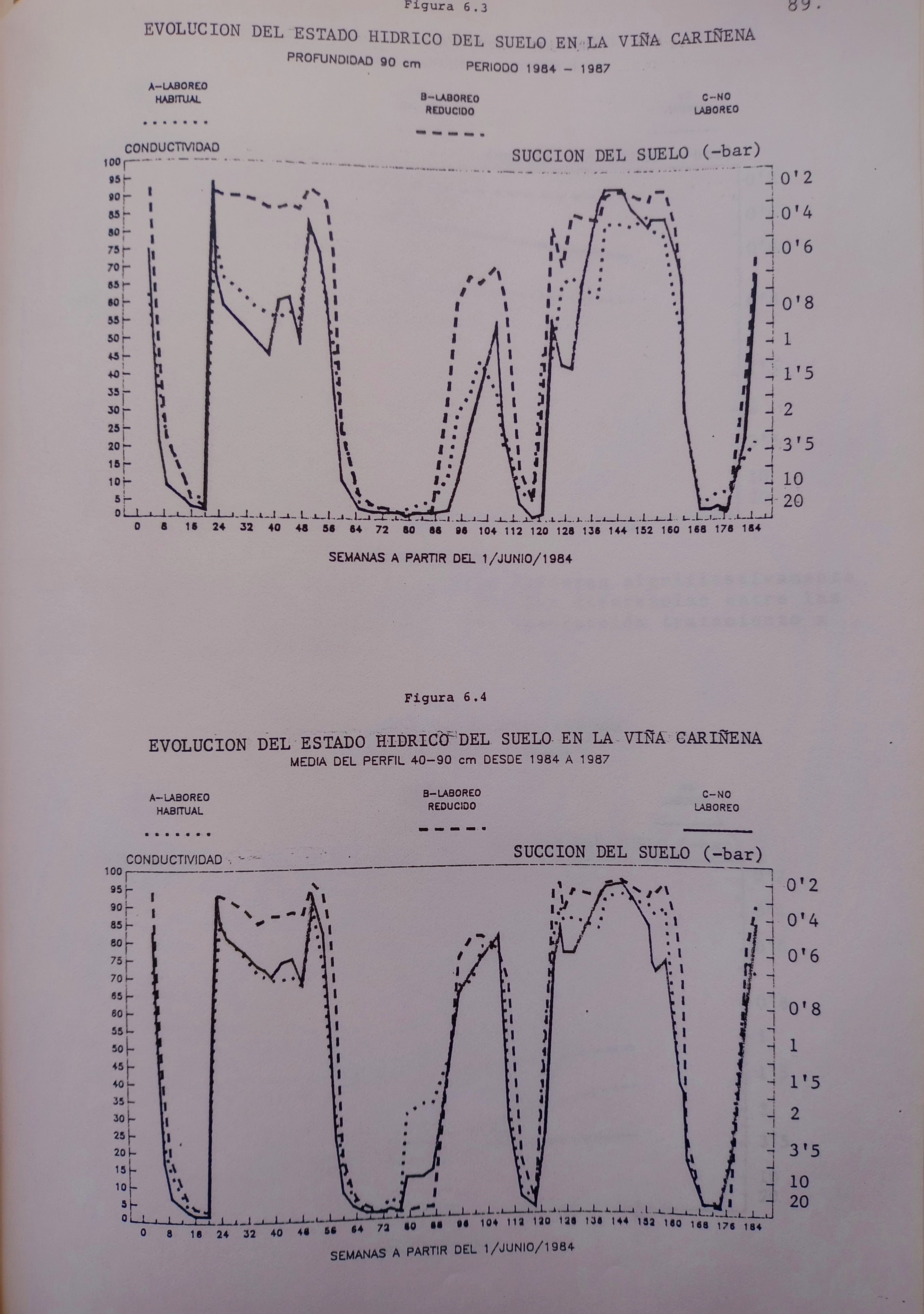
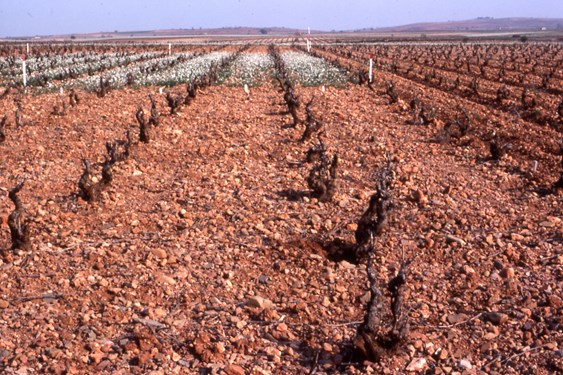
Se trata de una publicación antigua, parte de una Tesis Doctoral, que describe resultados de ensayos realizados en viñedos de secano en el noreste de España que aún puede ser útil tenerlos en cuenta.
Influence of Reduced Vineyard Tillage on Soil Water Status: This is an older publication, part of a PhD dissertation, describing the results of trials carried out in dry‑farmed vineyards in northeastern Spain. The findings may still be useful to keep in mind.
Some conclusions:
Back in 1988, we believed that the transpiration rate of grapevines in those soils—similar to what Miguel Pastor had observed in olive trees—was higher under no‑tillage (NT) than under tillage (T). For that reason, we obtained equal or sometimes higher yields in NT. It’s important to understand that at the time we did not study vine transpiration specifically, but rather the soil water status, vegetative growth (pruning wood), and yield (kg/vine) in the trial plots.
According to later studies, there is no clear evidence that vine transpiration increases under NT. What these studies do show is that the total evapotranspiration of the system (soil + plant) changes depending on soil management, which can lead to confusion. Vine transpiration depends mainly on available water, soil type, and vine vigor—not directly on the number of tillage operations. As you know, higher transpiration can increase growth and yield as long as the soil and plant water status allow it, meaning there is no water stress. When stress occurs, the vine closes its stomata and tries to survive without growing.
We found that timely tillage operations tend to increase the rate of water infiltration into the soil when rainfall is scarce. Under NT, infiltration is slower, which can cause losses through runoff (especially in compacted soils or even on very slight slopes) or through evaporation when warm or windy weather follows rainfall. For this reason, current recommendations include timely strip tillage to prevent runoff, or temporary cover crops—also in alternating rows—to improve infiltration.
However, the main advantage of NT is the greater efficiency of intact roots, which, because they are not disturbed by tillage, grow closer to the soil surface—an area generally more fertile—and can make better use of light rainfall. This reduces water stress to some extent and allows vines to produce as much or even more than under tilled conditions.
Indeed, growers in arid or semi‑arid dry‑farming regions continue to till, partly because herbicide treatments are more expensive and more complex (phytotoxicity, resistance issues) than the two or three tillage passes needed to control weeds. Besides, forty years ago a single residual herbicide (triazine‑based) was sufficient, but it is no longer available due to lack of authorization in Europe. As a result, the traditional method—cheap, simple, and now even considered “ecological”—is preferred.